# What Baserow architecture was created and why?
**URL:** https://community.baserow.io/t/what-baserow-architecture-was-created-and-why/1270
**Category:** Technical Help
**Created:** [August 30, 2022, 4:35am UTC](https://community.baserow.io/t/what-baserow-architecture-was-created-and-why/1270 "2022-08-30T04:35:14Z")
**Posts on this page:** 2
**Page:** 1
### Author:  [@anon6366911](https://community.baserow.io/u/anon6366911)
#### Post date: [August 30, 2022, 4:35am UTC](https://community.baserow.io/t/what-baserow-architecture-was-created-and-why/1270/1 "2022-08-30T04:35:14Z")
According to the [remote storage](https://remotestorage.io/protocol/) protocol, there are 3 types of application/software:
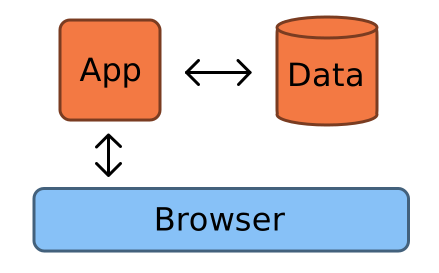
#### 1. Traditional Web Apps:
In hosted web stacks such as LAMP, .Net, Ruby on Rails, Django, etc…, the developer hosts the app and data, while the user controls device.
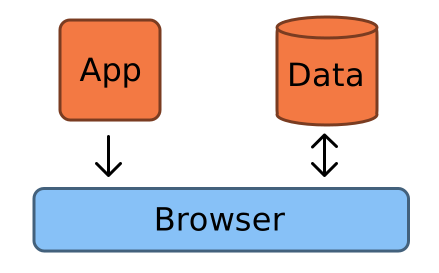
#### 2. No-Backend Web Apps
In 100% client-side apps that use CouchDB, Hoodie, Firebase, Parse, Kinto, etc…, the developer provides the app and data, while user controls the device.
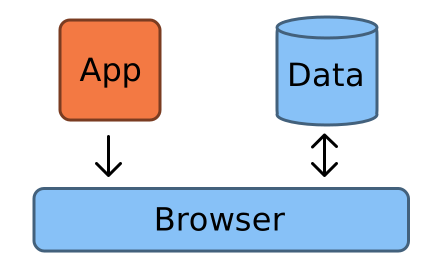
#### 3. Unhosted Web Apps
In 100% client-side apps that use remoteStorage, Google Drive, Dropbox, etc…, the developer provides only the app, while the user controls the device and data.
What Baserow architecture was created and why?
---
### Author:  [@bram](https://community.baserow.io/u/bram)
#### Post date: [September 15, 2022, 3:39pm UTC](https://community.baserow.io/t/what-baserow-architecture-was-created-and-why/1270/2 "2022-09-15T15:39:41Z")
Hi @anon6366911, I think that Baserow fits **1. Traditional web apps** the best. Because we’re open source and because we want it to be possible to self host 100% of Baserow, we’ve chose for this approach. More information about our architecture can be found here: [Baserow Technical Introduction // Baserow](https://baserow.io/docs/technical%2Fintroduction).